
Excessive barking can become frustrating for dog owners, especially when it happens repeatedly throughout the day or night. Dogs naturally communicate through barking, but frequent barking may be triggered by excitement, boredom, territorial behavior, unfamiliar sounds, separation, or environmental distractions. Finding a humane and practical way to manage unwanted barking is therefore important for maintaining a calmer home environment.
WoofAway is presented as a compact dog-training and barking-management device designed to help discourage unwanted barking. From its handheld design and simple controls to its directional front end, the device is intended to give owners another tool for addressing repetitive barking without relying on physical punishment.
But does a device like WoofAway make sense for everyday dog owners? How does it fit into a responsible training routine, and what should buyers consider before using it? This detailed review looks at the design, intended use, potential benefits, limitations, and practical considerations surrounding WoofAway.
What Is WoofAway?
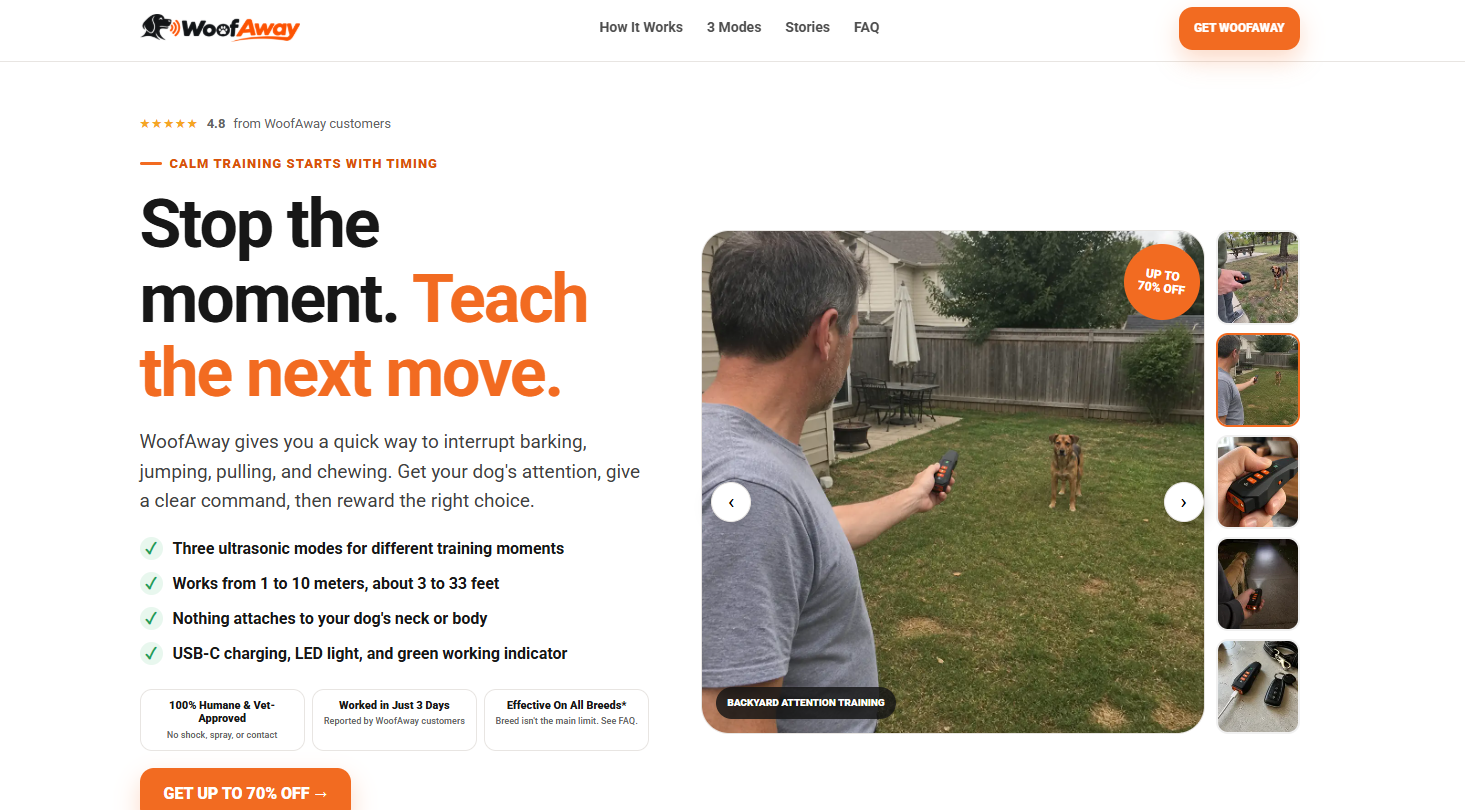
WoofAway is a handheld device marketed for helping owners manage excessive or unwanted barking. The product shown in the image has a compact black body with orange controls and a front-facing speaker/sensor area. Its design appears intended to make it easy to hold and point toward a barking dog when training is taking place.
The device also includes multiple buttons, indicator lights, and a rechargeable-style compact form factor. Rather than being worn continuously by a dog, a handheld product such as this can be used by an owner when a particular barking behavior occurs.
The basic idea is relatively straightforward: when unwanted barking happens, the owner activates the appropriate training response, allowing the dog to associate the unwanted behavior with a consistent signal.
However, WoofAway should not be viewed as a substitute for understanding why a dog is barking. Barking is communication, and the most effective approach generally combines training with identifying and addressing the underlying trigger.
Why Do Dogs Bark Excessively?
Before discussing any barking-management device, it is worth understanding that barking can have many causes.
A dog may bark because it:
- Wants attention
- Is excited
- Sees unfamiliar people or animals
- Hears noises outside
- Is protecting its territory
- Is bored or under-stimulated
- Experiences separation-related distress
- Is frightened or anxious
- Has learned that barking gets a desired response
For example, a dog that barks whenever someone walks past the front door may be reacting to movement and perceived intrusion. Another dog may bark because it has too much unused energy.
This distinction matters because simply stopping the barking does not necessarily solve the underlying problem.
WoofAway may potentially be more useful when incorporated into a broader training strategy rather than used as a standalone solution.
WoofAway Features and Design
One of the first things noticeable about WoofAway is its handheld construction.
The black-and-orange design gives the product a modern appearance, while the elongated body appears shaped for comfortable handling. The controls are positioned on the upper surface, making them relatively accessible while holding the device.
Compact Handheld Form
A handheld design can be convenient because owners can keep the device nearby when training. It does not require fitting equipment onto the dog, which may be preferable for owners who do not want to use wearable training products.
Multiple Controls
The device shown in the supplied image features several orange buttons with different symbols. This suggests that the product may offer different operating functions or training modes.
Because exact specifications can vary by model or seller, users should check the manufacturer’s current instructions before assuming what each button does.
Indicator Lights
A small indicator area is visible near the controls. Indicator lights can be useful for showing operational or battery status, helping the owner understand when the device is active or needs charging.
Directional Front Section
The front of WoofAway contains a prominent circular component alongside another opening. This part appears designed to direct the device’s output toward the intended area.
For responsible use, owners should follow the manufacturer’s instructions rather than simply pointing the device at a dog at close range.


How WoofAway May Be Used
A barking-management device is generally most useful when paired with consistent training.
Suppose a dog repeatedly barks at passing pedestrians. Instead of reacting with shouting, the owner can establish a consistent training routine.
When the dog notices the trigger and begins barking, the owner can calmly use the device according to its instructions. Once the dog becomes quiet, the owner can reinforce the desired behavior with praise, attention, or another appropriate reward.
The goal should not simply be to suppress every vocalization. Instead, the objective is to teach the dog when barking is unnecessary and reinforce calm behavior.
Consistency is particularly important.
If an owner uses a training device one day but ignores the same behavior the next day, the dog may receive mixed signals. Clear routines tend to make behavioral training easier to understand.
Potential Benefits of WoofAway
1. Portable Design
Because WoofAway is handheld, it can potentially be used in different areas of the home or yard. Owners do not necessarily have to install a permanent system.
2. Simple Controls
The dedicated buttons shown on the device may make operation straightforward once the owner understands the controls and follows the instructions.
3. No Wearable Collar Required
Some owners prefer training approaches that do not involve putting an electronic device on their dog’s neck. A handheld format provides an alternative approach.
4. Can Support Consistent Training
Used appropriately, a barking-management device may help owners establish a consistent response to unwanted barking.
5. Reusable Training Tool
Unlike disposable products, a rechargeable or reusable handheld device can potentially be used repeatedly during training sessions.
Is WoofAway Safe for Dogs?
Safety should be one of the most important considerations when using any training device around an animal.
Owners should always read and follow the product’s instructions before using WoofAway. The device should never be used as a tool for frightening, hurting, or punishing a dog.
It is also important to remember that some dogs are particularly sensitive to sounds or training stimuli. If a dog shows signs of distress, fear, panic, or worsening behavior, the owner should stop using the device and consider consulting a qualified veterinarian or professional dog trainer.
The product should be used as part of responsible behavior management—not as a way to intimidate an animal into silence.
WoofAway and Positive Reinforcement
One of the strongest ways to make barking training more effective is to reinforce the behavior you actually want.
For instance, if your dog stops barking and remains calm after noticing someone outside, rewarding that calm behavior can help establish a positive association.
Rewards can include:
- Verbal praise
- Petting
- A small appropriate treat
- A favorite toy
- Calm attention
The precise reward depends on what motivates the individual dog.
WoofAway, if used, should therefore be considered one component of a larger training routine rather than the entire training program.
Situations Where WoofAway May Be Useful
WoofAway could potentially be considered by owners dealing with repetitive barking associated with relatively identifiable triggers.
Examples may include barking at:
- People approaching the home
- Passing vehicles
- Outdoor noises
- Other dogs
- Visitors
- General environmental distractions
However, persistent barking caused by fear, anxiety, pain, separation distress, or other behavioral problems may require a different approach.
If the barking suddenly becomes much more frequent or unusual, it can also be sensible to speak with a veterinarian to rule out an underlying health issue.

What WoofAway May Not Solve
No barking-management device should be expected to solve every behavioral problem.
A device cannot automatically determine why a dog is barking. It also cannot provide exercise, companionship, environmental enrichment, or professional behavioral assessment.
If a dog is barking because it is bored, for example, simply interrupting the barking does not remove the boredom.
Similarly, if a dog experiences separation anxiety, suppressing vocalization without addressing the anxiety may leave the underlying issue unresolved.
Owners should therefore consider the dog’s daily routine as a whole.
Regular exercise, mental stimulation, obedience training, appropriate socialization, and a predictable environment can all contribute to healthier behavior.
Tips for Getting Better Results
If you decide to use WoofAway, a thoughtful training approach can make a significant difference.
Start With the Trigger
Identify what causes the barking. Understanding the trigger allows you to create a more targeted training strategy.
Stay Calm
Yelling at a barking dog can sometimes increase excitement rather than reduce it. Keep your own reactions controlled.
Reward Quiet Behavior
Whenever the dog responds appropriately and becomes calm, reinforce that behavior.
Be Consistent
Use the same commands and expectations every time the relevant behavior occurs.
Avoid Overuse
A training device should not be activated continuously or used excessively. Follow the manufacturer’s directions and pay attention to your dog’s reactions.
Give Your Dog Enough Activity
Exercise and mental stimulation can be particularly important for energetic dogs. Walks, play sessions, training games, and enrichment activities can help address boredom-related behavior.
WoofAway Pros and Cons
Pros
- Compact handheld design
- Easy to carry around
- Multiple visible controls
- Does not need to be worn as a collar
- Can complement a structured training routine
- Useful for addressing certain repetitive barking situations
Cons
- May not work equally well for every dog
- Does not identify the underlying reason for barking
- Requires consistent owner involvement
- Not a replacement for professional behavioral assistance
- Specifications and operating modes should be verified from the current product instructions
Final Verdict: Is WoofAway Worth Considering?
WoofAway presents itself as a compact and convenient option for dog owners looking for an additional tool to manage excessive barking. Its handheld design, dedicated controls, and portable form make it potentially practical for use during training sessions.
The most important point, however, is that barking is normal canine communication. The objective should not be to eliminate all barking, but to teach a dog when excessive or unnecessary barking is inappropriate.
For that reason, WoofAway is best considered as part of a broader approach that includes positive reinforcement, exercise, mental stimulation, clear commands, and an understanding of the dog’s individual triggers.
Owners should also use the device responsibly and according to its instructions. If a dog displays anxiety, fear, aggression, or other significant behavioral changes, professional guidance from a veterinarian or qualified trainer is a better next step than simply increasing the use of a barking-management device.
Overall, WoofAway may be worth considering for owners who want a portable training aid for specific barking situations, particularly when it is combined with patient and consistent behavioral training. The device itself is only one part of the process; the owner’s understanding, timing, consistency, and commitment to humane training ultimately play a much larger role in achieving a calmer household.