Excess moisture inside the home can create several problems, including condensation on windows, damp-smelling rooms, uncomfortable indoor air, and conditions that encourage mold and mildew growth. Bathrooms, bedrooms, basements, laundry areas, and poorly ventilated spaces are particularly susceptible to humidity. Finding a practical way to manage indoor moisture can help make these spaces more comfortable and easier to maintain.
The Drydon Dehumidifier is presented as a compact home appliance designed for people who want a convenient way to manage excess humidity in their living spaces. Its minimalist white exterior, compact-looking design, simple power button, top ventilation grille, and visible water-level window give it a clean, modern appearance that may complement different interior styles.
For people who prefer straightforward household appliances rather than large, complicated machines, a small dehumidifier may be worth considering. However, the most important factors are its actual moisture-removal capacity, tank size, noise level, room coverage, energy consumption, and maintenance requirements.
In this review, we will explore the Drydon Dehumidifier’s appearance, potential benefits, operating principles, important considerations, and practical buying advice. Because detailed, independently verified specifications are not available here, features such as extraction capacity, automatic shutoff, operating modes, and room coverage should be confirmed with the seller before purchasing.
What Is Drydon Dehumidifier?
Drydon Dehumidifier is a product name associated with a compact dehumidifying appliance intended for indoor moisture management. A dehumidifier works by removing some of the water vapor present in the air and collecting that moisture in a reservoir or directing it through a drainage system.
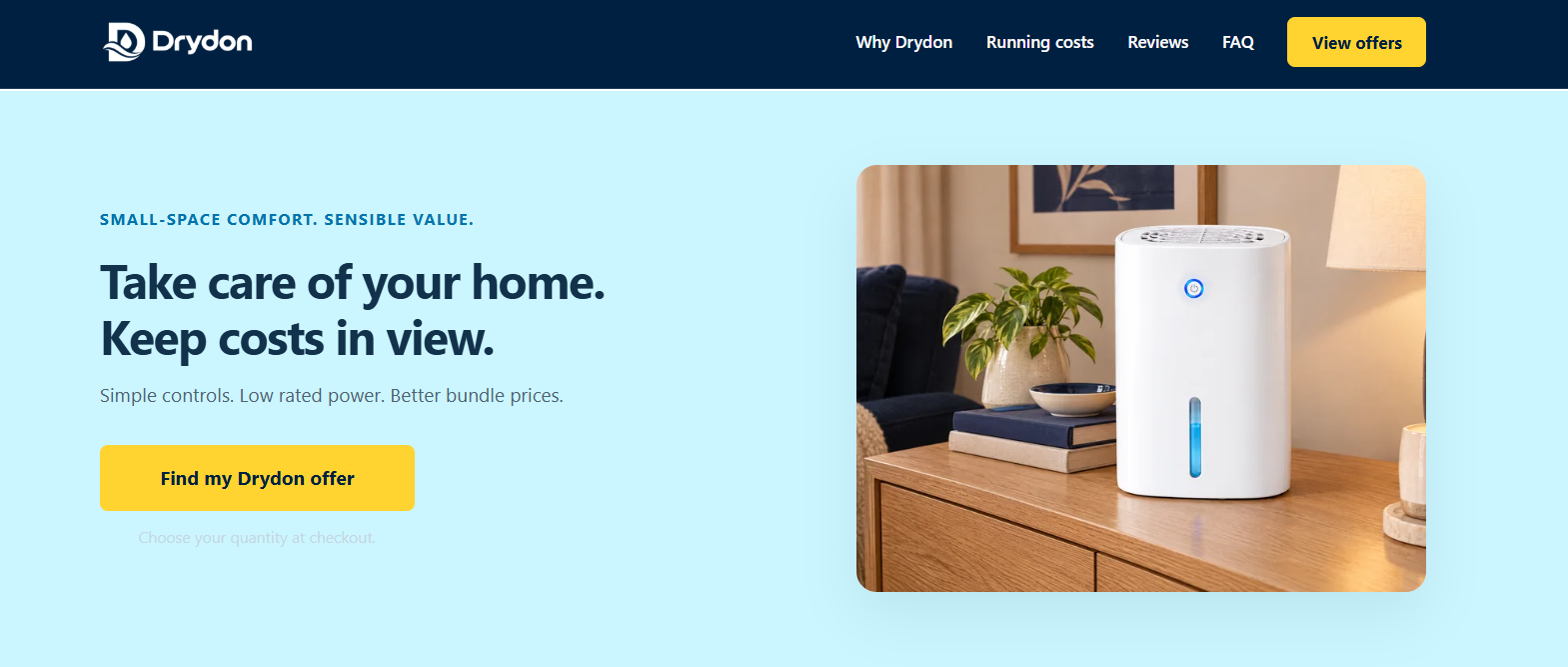
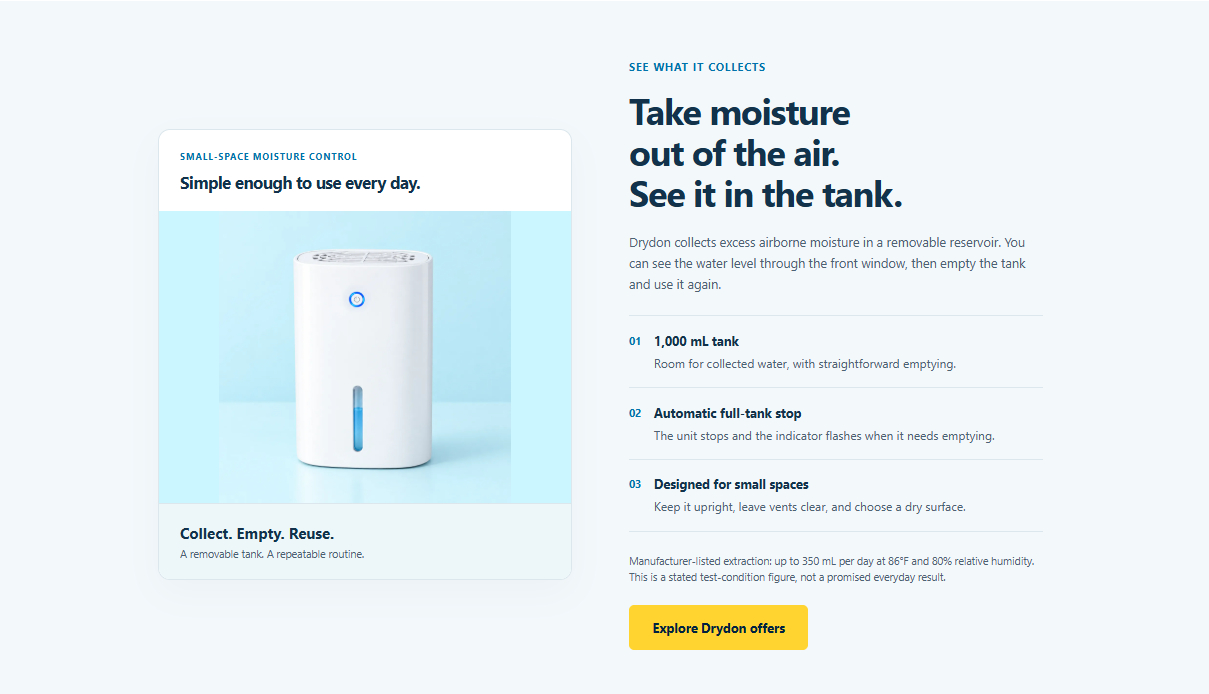
The product image shows a white, upright appliance with rounded edges, a ventilation grille on the top, a blue illuminated power button, and a narrow transparent water-level window on the front. Its appearance suggests an emphasis on simple operation and a contemporary design.
A compact unit may be useful in a small bedroom, bathroom, wardrobe area, home office, or other enclosed space, provided its actual capacity is suitable for the room. Larger rooms and areas with serious dampness may require a higher-capacity compressor dehumidifier or professional investigation of the underlying moisture source.
It is important to distinguish between the product’s visual design and its verified technical performance. The image alone cannot establish how much moisture the appliance removes, whether it uses thermoelectric or compressor technology, or how large an area it can effectively serve.
How Does Drydon Dehumidifier Work?
Dehumidifiers reduce indoor humidity through different technologies. The exact mechanism used by Drydon should be checked in its official specifications or product manual.
1. Air Intake
A typical dehumidifier draws humid air into the appliance through an intake opening. Internal components then process the air to separate some of its moisture.
The ventilation grille visible on the top of Drydon may form part of its airflow system, although the image does not establish the precise direction of airflow.
2. Moisture Removal
Depending on the technology, a dehumidifier may cool air so that water vapor condenses into liquid, or use a moisture-absorbing material to capture water from the air.
Thermoelectric models are often compact and relatively simple but generally remove less moisture than larger compressor-based appliances. Compressor models are commonly more suitable for removing substantial quantities of moisture from larger areas.
Buyers should check which technology Drydon uses before deciding whether it meets their needs.
3. Water Collection
Moisture removed from the air is commonly collected in an internal water tank. The transparent blue window on the front of the pictured Drydon appliance appears designed to make the water level easier to see.
A visible water reservoir can help users recognize when maintenance may be necessary. However, the actual tank capacity and whether the appliance stops automatically when the tank is full must be verified.
4. Air Circulation
Once moisture has been removed, the appliance returns processed air to the surrounding room. Continuous operation may gradually reduce humidity if the unit is appropriately sized for the space and the room’s moisture load.
Results depend on room size, temperature, ventilation, moisture sources, and the appliance’s extraction capacity.
Key Features of Drydon Dehumidifier
Compact and Modern Appearance
One noticeable feature is the minimalist white design. Rounded corners and a smooth exterior give the appliance a simple appearance that may fit naturally into bedrooms, offices, and other indoor environments.
A compact design can be especially appealing to people with limited floor space. Nevertheless, actual dimensions and weight should be checked before purchasing.
Simple Power Control
The front panel features a clearly visible power symbol surrounded by a blue illuminated ring. This gives the appliance an uncomplicated appearance and may make the main control easy to locate.
The image does not confirm whether additional settings, humidity controls, timers, or operating modes are available.
Visible Water-Level Window
The narrow blue window on the front appears intended to show the water level inside the reservoir. This can be convenient because users may be able to check the collection level without opening the appliance.
The product manual should explain how to empty the tank and whether any indicator or automatic shutoff function is included.
Top Ventilation Grille
The upper grille is a visible part of the appliance’s design. Ventilation openings are important in many dehumidifiers because air needs to circulate through the internal system.
For safe and effective operation, the unit should be positioned according to its manufacturer’s clearance requirements. Blocking ventilation openings can reduce performance and may cause overheating in appliances that require unobstructed airflow.
Neutral Color Scheme
The white finish gives Drydon a neutral look that may suit modern interiors. Unlike appliances with prominent decorative colors, a plain white exterior can blend into many household settings.
Appearance, however, should be secondary to reliable performance, electrical safety, warranty coverage, and suitability for the intended room.
Potential Benefits of Drydon Dehumidifier
1. Helps Manage Excess Indoor Moisture
A properly sized dehumidifier can help reduce excessive indoor humidity. This may be useful in rooms where moisture accumulates because of showering, cooking, drying clothes indoors, or limited ventilation.
The effectiveness of Drydon will depend on its verified moisture-removal rate and the amount of moisture entering the room.
2. May Help Reduce Condensation
High indoor humidity can contribute to condensation on cold windows, walls, and other surfaces. Reducing humidity may help limit condensation under suitable conditions.
However, condensation can also be influenced by poor insulation, cold surfaces, and inadequate ventilation. A dehumidifier cannot correct every underlying cause.
3. Supports a More Comfortable Indoor Environment
Excessive humidity can make a room feel damp and uncomfortable, particularly in warm weather. Maintaining a more appropriate humidity level may improve comfort for occupants.
A practical starting point for many homes is approximately 30%–50% relative humidity, adjusted for the climate, season, building conditions, and individual comfort. A separate hygrometer can help determine whether humidity is actually high.
4. May Help Control Musty Odors
Damp areas sometimes develop unpleasant musty smells associated with persistent moisture and microbial growth. By lowering humidity, a suitable dehumidifier may help address one factor contributing to these odors.
Persistent odors should not simply be masked. Leaks, wet materials, mold growth, and drainage problems need to be identified and corrected.
5. Useful for Small Enclosed Spaces
If Drydon has a low extraction capacity, it may be best suited to a small enclosed room, cabinet-adjacent area, or other limited space. Its actual suitability depends on its performance specifications.
A small appliance should not be assumed to control humidity throughout an entire house.
6. Straightforward Visual Monitoring
The visible water-level window may make it easier to inspect the collection reservoir. This can help users develop a routine for checking the appliance and emptying the tank when necessary.
The convenience of this feature depends on the reservoir’s design and capacity.
7. A Simple Addition to Home Maintenance
A dehumidifier can complement regular ventilation, leak prevention, bathroom exhaust fans, and prompt drying of wet surfaces. When used appropriately, it may form part of a broader strategy for managing household moisture.
It should not replace essential repairs or appropriate ventilation.
Who May Consider Using Drydon Dehumidifier?
Drydon may be worth investigating for several types of users, depending on its specifications.
Apartment residents: People living in small apartments may appreciate a compact appliance that does not occupy excessive space.
Bedroom users: Those who notice persistent dampness in a bedroom may consider a suitably sized dehumidifier, provided it operates at an acceptable noise level.
Home-office users: A small unit may be convenient for an enclosed workspace affected by excessive humidity.
People living in humid climates: Residents of humid regions may benefit from humidity monitoring and appropriate moisture control. In very humid conditions, however, a small unit may not have sufficient capacity.
Households experiencing occasional condensation: A dehumidifier may help where excess indoor humidity contributes to condensation, although insulation and ventilation may also need attention.
For bathrooms, wet laundry rooms, large basements, and areas affected by substantial water intrusion, buyers should verify that the product is designed for the moisture load and environment involved.
How to Use Drydon Dehumidifier
The following steps describe general dehumidifier practices. Always follow the actual Drydon manual if its instructions differ.
Step 1: Choose a Suitable Location
Place the appliance on a stable, level surface in the intended room. Keep the air openings clear and leave the manufacturer’s recommended clearance around the unit.
Avoid locations where water can splash onto electrical components.
Step 2: Check the Electrical Requirements
Confirm the appliance’s rated voltage, plug type, and electrical safety instructions before connecting it to a power source.
Do not use a unit with a damaged cord or plug.
Step 3: Switch on the Appliance
Use the power control according to the product manual. If the appliance has adjustable settings, select an appropriate mode for the room and your humidity-control needs.
Do not assume that the pictured power button confirms the presence of automatic or programmable functions.
Step 4: Monitor Indoor Humidity
A separate digital hygrometer can help you understand whether the room is too humid and whether conditions improve over time.
If humidity remains high despite continuous operation, the appliance may be undersized or the room may have an unresolved moisture source.
Step 5: Inspect and Empty the Reservoir
Check the water-level window regularly. Empty the tank according to the manual and reinstall it correctly before restarting the appliance.
Do not assume that the unit has an automatic full-tank shutoff unless the manufacturer confirms this feature.
Step 6: Clean and Maintain the Unit
Clean the exterior with an appropriate cloth and maintain filters or other components as instructed by the manufacturer. Disconnect the appliance from power before carrying out maintenance that requires access to internal or removable parts.
Regular maintenance helps preserve airflow and reliable operation.

Pros and Cons of Drydon Dehumidifier
Potential Pros
- Minimalist white design with rounded edges.
- Compact-looking form that may suit smaller spaces.
- Visible water-level window.
- Simple front-mounted power control.
- May help manage excess humidity when correctly sized.
- Can complement other household moisture-control measures.
Potential Cons
- Verified moisture-extraction capacity is not established here.
- Actual room coverage and reservoir capacity need confirmation.
- Noise level and energy consumption are unknown.
- Automatic shutoff and timer functions are unconfirmed.
- A compact unit may be unsuitable for large or severely damp areas.
- Purchase price, warranty, replacement-part availability, and customer-service quality need checking.
These points distinguish visible design characteristics from specifications that still require verification.
Important Things to Check Before Buying
Before ordering Drydon, review the following details carefully.
Moisture-removal capacity: Look for a specification in liters per day or pints per day, ideally measured under stated temperature and humidity conditions.
Recommended room size: Confirm the manufacturer’s coverage guidance and whether it applies to your room’s conditions.
Tank capacity: A small reservoir may require frequent emptying, especially in a humid environment.
Noise rating: If the appliance will operate near a bed or desk, check the sound level in decibels.
Energy consumption: Look for rated wattage and information about expected electricity use. Actual consumption depends on operating time and conditions.
Safety features: Confirm whether it has overheat protection, a full-tank shutoff, and appropriate electrical safety certification.
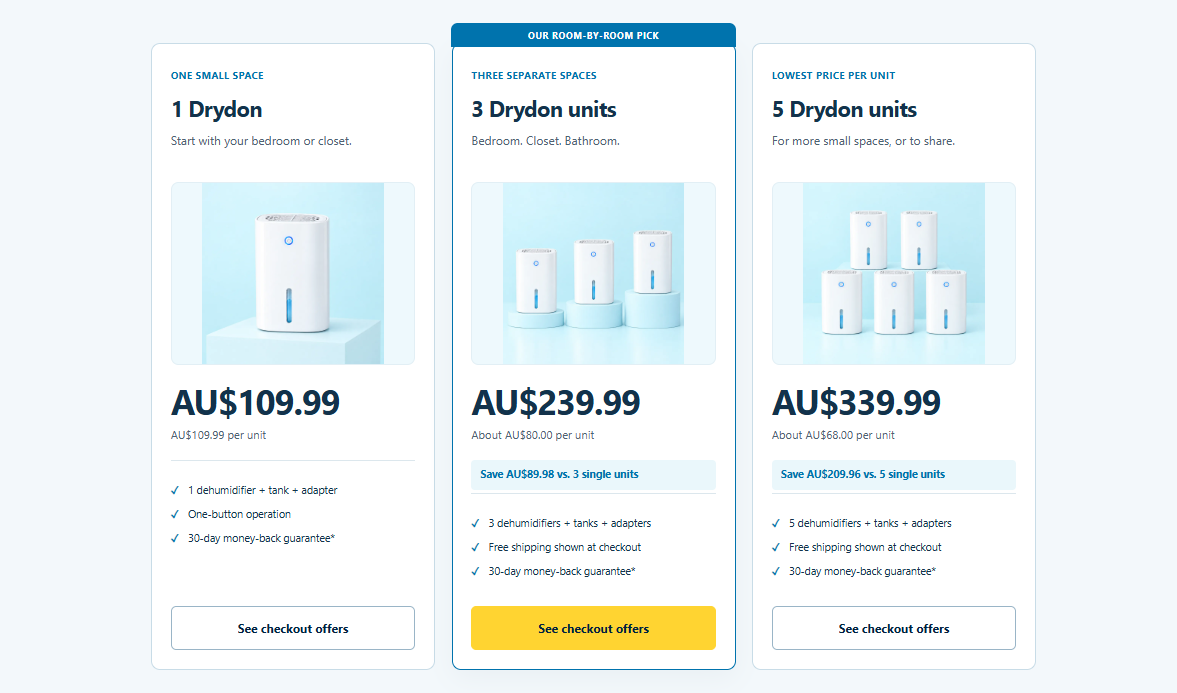
Price and warranty: Compare the final price, shipping charges, return period, warranty duration, and availability of support.
Seller reliability: Buy from a seller that clearly identifies the manufacturer, provides verifiable contact details, and publishes understandable return and warranty terms.
Do not rely solely on promotional claims or product photographs when evaluating performance.
Is Drydon Dehumidifier Suitable for Mold Prevention?
Humidity management can be part of mold prevention, but a dehumidifier is not a complete mold-removal solution.
The US Environmental Protection Agency recommends keeping indoor relative humidity below 60%, ideally between 30% and 50% when practical, to help discourage mold growth. A hygrometer can help monitor conditions.
If mold is already present, the affected materials may require cleaning or professional remediation. Water leaks and other sources of moisture must be repaired, and wet materials should be dried promptly.
A small dehumidifier should not be expected to resolve major leaks, extensive mold contamination, or moisture entering through foundations and walls. Its ability to contribute to prevention depends on whether it can maintain appropriate humidity throughout the relevant space.
Drydon Dehumidifier Compared With Larger Dehumidifiers
Compact dehumidifiers and larger compressor units serve different purposes.
Compact models may offer a smaller footprint and convenient placement. They may be appropriate for limited spaces with modest moisture loads, depending on their actual capacity.
Larger compressor models generally remove substantially more water and are often better suited to larger rooms, basements, or persistently humid environments. They may also offer larger tanks or continuous drainage options, although their dimensions, sound levels, and energy requirements vary.
The right choice depends on the room, climate, moisture source, and measured humidity—not simply the product’s appearance.
For a large room or persistent dampness problem, compare extraction capacity and independent performance information before choosing a compact appliance.
Frequently Asked Questions
1. What is Drydon Dehumidifier used for?
It is presented as a compact appliance for indoor humidity management. Its suitability depends on its verified extraction capacity, room coverage, and operating conditions.
2. Can Drydon Dehumidifier eliminate mold?
A dehumidifier may help reduce conditions that encourage mold growth by lowering excessive humidity. It does not remove established mold or repair leaks and water damage.
3. Is Drydon Dehumidifier suitable for a bedroom?
It may be suitable if its moisture-removal capacity and noise level meet your needs. Check the manufacturer’s room-size recommendations before using it in a bedroom.
4. How often should the water tank be emptied?
This depends on the tank’s capacity, indoor humidity, and how long the appliance operates. Inspect the reservoir regularly and follow the manufacturer’s instructions.
5. Does Drydon Dehumidifier turn off automatically?
The product image does not confirm an automatic shutoff function. Check the official specification sheet or manual before purchasing.
6. Does it consume a lot of electricity?
Energy consumption depends on the unit’s rated wattage and operating time. Verify the electrical specifications and calculate expected usage based on your local electricity tariff.
7. Is Drydon suitable for a large basement?
Do not assume that a compact appliance can handle a large basement. Check its verified extraction rate and recommended coverage. A higher-capacity model may be more appropriate.
8. Where should buyers purchase it?
Consider purchasing through an official or otherwise reputable seller that provides clear specifications, a verifiable warranty, secure payment options, and a transparent return policy.
Final Verdict: Is Drydon Dehumidifier Worth Considering?
The Drydon Dehumidifier has a clean, minimalist appearance, a visible water-level window, a top ventilation grille, and a straightforward front-mounted power control. These design elements may appeal to people looking for an appliance that fits neatly into a modern home.
Its potential value, however, depends on more than appearance. Moisture-removal capacity, tank size, room coverage, noise, energy use, safety features, warranty protection, and seller reliability are essential factors to evaluate.
For a small room with a modest humidity problem, a compact dehumidifier may be a practical option if its verified specifications match the conditions. For larger spaces or serious dampness, a higher-capacity appliance and investigation of the underlying moisture source may be necessary.
Our recommendation: Consider Drydon only after confirming its technical specifications, price, return policy, and warranty with the seller. Avoid assuming that it removes a particular amount of water, covers a specific room size, or includes automatic functions unless those details are documented.
Ultimately, the best dehumidifier is one that can maintain an appropriate humidity level for your space safely, efficiently, and consistently. Drydon’s design may be appealing, but verified performance should guide the final purchasing decision.